When you buy through links on our articles, Future and its syndication partners may earn a commission.

This article was originally published at The Conversation. The publication contributed the article to Space.com's Expert Voices: Op-Ed & Insights.
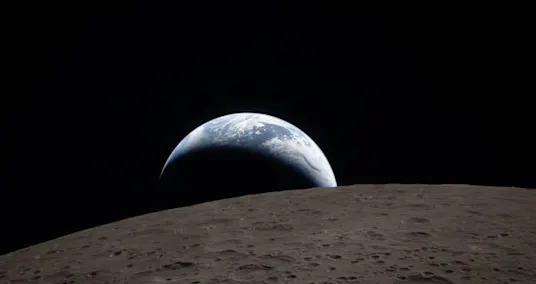
The first step on the moon was one of humanity's most exciting accomplishments. Now scientists are planning return trips – and dreaming of Mars beyond.
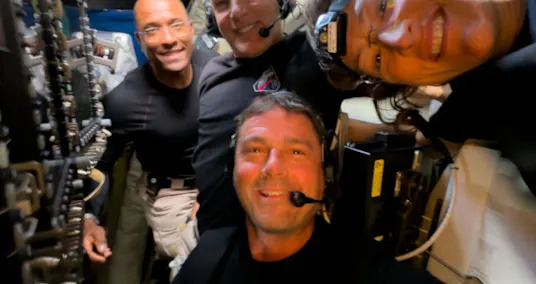
Next year, Nasa's Artemis II mission will send four astronauts to fly around the moon to test the spacecraft before future landings. The following year, two astronauts are expected to explore the surface of the moon for a week as part of Nasa's Artemis III mission.
And finally, the trip to Mars is planned for the 2030s. But there's an invisible threat standing in the way: cosmic rays.
When we look at the night sky, we see stars and nearby planets. If we're lucky enough to live somewhere without light pollution, we might catch meteors sliding across the sky. But cosmic rays – consisting of protons, helium nuclei, heavy ions and electrons – remain hidden. They stream in from exploding stars (galactic cosmic rays) and our very own sun (solar particle events).
They don't discriminate. These particles carry so much energy and move so fast that they can knock electrons off atoms and disrupt molecular structures of any material. That way, they can damage everything in their path, machines and humans alike.
The Earth's magnetic field and atmosphere shield us from most of this danger. But outside Earth's protection, space travellers will be routinely exposed. In deep space, cosmic rays can break DNA strands, disrupt proteins and damage other cellular components, increasing the risk of serious diseases such as cancer.
The research challenge is straightforward: measure how cosmic rays affect living organisms, then design strategies to reduce their damage.
Ideally, scientists would study these effects by sending tissues, organoids (artificially made organ-like structures) or lab animals (such as mice) directly into space. That does happen, but it's expensive and difficult. A more practical approach is to simulate cosmic radiation on Earth using particle accelerators.
Cosmic ray simulators in the US and Germany expose tissues, plants and animals to different components of cosmic rays in sequence. A new international accelerator facility being built in Germany will reach even higher energies, matching levels found in space that have never been tested on living organisms.
But these simulations aren't fully realistic. Many experiments deliver the entire mission dose in a single treatment. This is like using a tsunami to study the effects of rain.
In real space, cosmic rays arrive as a mixture of high-energy particles hitting simultaneously, not one type at a time. My colleagues and I have suggested building a multi-branch accelerator that could fire several tuneable particle beams at once, recreating the mixed radiation of deep space under controlled laboratory conditions. For now, though, this kind of facility exists only as a proposal.
Beyond better testing, we need better protection. Physical shields seem like the obvious first defense. Hydrogen-rich materials such as polyethylene and water-absorbing hydrogels can slow charged particles. Although they are used, or planned to be used, as spacecraft materials, their benefits are limited.
Particularly galactic cosmic rays, the ones that arrive from far exploding stars, are so energetic that they can penetrate through physical shielding. They can even generate secondary radiation that increases exposure. So, effective protection by using solely physical shields remains a major challenge.

Nature's armor
That's why scientists are exploring biological strategies. One approach is to use antioxidants. These molecules can protect DNA from harmful chemicals that are produced when cosmic rays hit living cells.
Supplementing with CDDO-EA, a synthetic antioxidant, reduces cognitive damage caused by simulated cosmic radiation in female mice. In the study, mice exposed to simulated cosmic radiation learned a simple task more slowly compared to unexposed mice. However, mice that received the synthetic antioxidant performed normally despite being exposed to simulated cosmic radiation.
Another approach involves learning from organisms with extraordinary abilities. Hibernating organisms become more resistant to radiation during hibernation. The mechanisms on how hibernation protects from radiation are not fully understood yet. Still, inducing hibernation-like conditions in non-hibernating animals is possible and can make them more radioresistant.
Tardigrades – microscopic creatures also known as water bears – are also extremely radioresistant, especially when dehydrated. Although we can't hibernate or dehydrate astronauts, the strategies these organisms use to protect cellular components might help us preserve other organisms during long space journeys.
Microbes, seeds, simple food sources and even animals that could later become our companions might be kept in a protected state for a while. Under calmer conditions, they could then be brought back to full activity. Therefore, understanding and harnessing these protective mechanisms could prove crucial for future space journeys.
A third strategy focuses on supporting organisms' own stress responses. Stressors on Earth, such as starvation or heat, have driven organisms to evolve cellular defenses that protect DNA and other cellular components. In a recent preprint (a paper that is yet to be peer reviewed), my colleague and I suggest that activating these mechanisms through specific diets or drugs may offer additional protection in space.
Physical shields alone won't be enough. But with biological strategies, more experiments in space and on Earth, and the construction of new dedicated accelerator complexes, humanity is getting closer to making routine space travel a reality. With current speed, we are probably decades away from fully solving cosmic-ray protection. Greater investment in space radiation research could shorten that timeline.
The ultimate goal is to journey beyond Earth's protective bubble without the constant threat of invisible, high-energy particles damaging our bodies and our spacecraft.
NEUESTE BEITRÄGE
- 1
 Meet the Artemis crew in NASA's first astronaut mission to the moon in more than a half-century28.03.2026
 - 2An Ideal Getaway - Spots for Solo Travel06.06.2024
- 3The most effective method to Succeed in Your Profession with a Web based Advertising Degree19.10.2023
- 4Twelve injured near Beit Shemesh, reports of shrapnel impact in Eilat as Iran targets Israel28.03.2026
- 5Unpaid caregiving work can feel small and personal, but that doesn’t take away its ethical value17.12.2025
- 6Clocks to go forward one hour in Europe as summer time starts28.03.2026
- 7Lebanon says Israeli strike killed 13 people near Palestinian refugee camp18.11.2025
- 8Cyprus urges hotels to open up, pours funding into tourism27.03.2026
- 9Raw oysters linked to ongoing salmonella outbreak infecting 64 across 22 states: CDC23.12.2025
- 10NASA troubleshoots Artemis II toilet problem in otherwise smooth flight04.04.2026
- 11AI’s errors may be impossible to eliminate – what that means for its use in health care11.12.2025
- 12Ariana Grande and Jonathan Bailey will reunite for 'Sunday in the Park With George'14.01.2026
- 13All that You Really want to Be aware of Dental Inserts Facilities01.01.1
- 144K televisions for Extreme Film Watching Experience05.06.2024
- 15AstraZeneca to acquire Modella AI to speed oncology drug research13.01.2026










Ähnliche Artikel
- Artemis 2 captures historic 'Earthset' photo | Space photo of the day for April 7, 202607.04.2026
- Tesla Germany Registrations Quadruple to 9,252 Vehicles in Best March Ever07.04.2026
- What's going on with Katseye? The Manon Bannerman hiatus drama, explained.07.04.2026
- Two IDF officers, civilian face indictment in alleged Gaza aid-truck smuggling scheme07.04.2026
- West Palm Beach Shorecrest, renderings of downtown waterfront condo07.04.2026
- Artemis II astronauts make long-distance call to the space station as they head home from the moon07.04.2026
- Tuesday, April 7. Russia’s War On Ukraine: News And Information From Ukraine07.04.2026
- The Eastern Bongo, Kenya’s Rare Forest Antelope on the Brink07.04.2026
- U.K. blocks Kanye West from entering Britain to headline now canceled festival: What led to the ban07.04.2026
- Russia confirms 16 Cameroonian soldiers killed in Ukraine war07.04.2026
- First Phosphate advances battery-grade phosphate project as analysts highlight strategic Federal support07.04.2026
- After fleeing past Hezbollah fighting, some Israelis on northern border vow to stay07.04.2026
- 'Unreal' solar eclipse: Artemis 2 crew just saw one of the rarest sights in spaceflight history07.04.2026
- Chinese construction workers in Israel: 'I’d rather be bombed than live in poverty'07.04.2026
- Broken toilet, T-shirts on windows and collecting saliva: The weirdness of daily life aboard Orion07.04.2026
- Czech Republic caps fuel prices amid Iran war energy crisis07.04.2026
- NASA releases stunning new images captured by the Artemis II moon mission, including 'Earthset' and a solar eclipse from space07.04.2026
- Amid Iran war, 53 of Israel's future scientists showcase projects in Jerusalem contest07.04.2026
- Iranian-linked drone attack kills Kurdish couple in northern Iraq07.04.2026
- Thousands of small fish defy gravity to climb Congo waterfall07.04.2026